
Research and Development
Developing standards: second-life lithium-ion batteries
September 2026: The report Second-Life Lithium-Ion Battery Systems weighs whether to build remanufacturing into AS 5377 or adopt a leading international standard.
Building off the back of this work for Powering Australia by Ratel Consulting LLC, ABRI co-hosted a workshop to work through how Australia can adopt standards for reusing and repurposing batteries. Report on workshop findings
The day brought together industry, government, research and professional services to discuss learnings from what already works overseas, so reused batteries can be trusted, financed and insured in Australia. Whilst there are still factors to be explored, four key themes emerged:
Development of a reuse and repurposing standard should be prioritised based on UL 1974 and drawing on IEC63330-1 so that it covers EV and energy storage batteries.
Implementation should initially be voluntary and marketing claims by participating companies need to be clear.
Framework will also need other supporting tools to ensure successful development of a viable battery reuse and repurposing industry in Australia.
Pilot projects would provide learnings to support Australian market development.
Battery Materials Recovery Industry Profile
Prepared by Positive Economics Advisory, the report provides a comprehensive snapshot of Australia’s battery circular economy and underscores its strategic importance. Australia’s battery materials recovery industry is already delivering measurable impact, contributing $2.1 billion to the economy and supporting 19,450 jobs—with projections to grow to $6.9 billion and over 34,600 jobs by 2050.
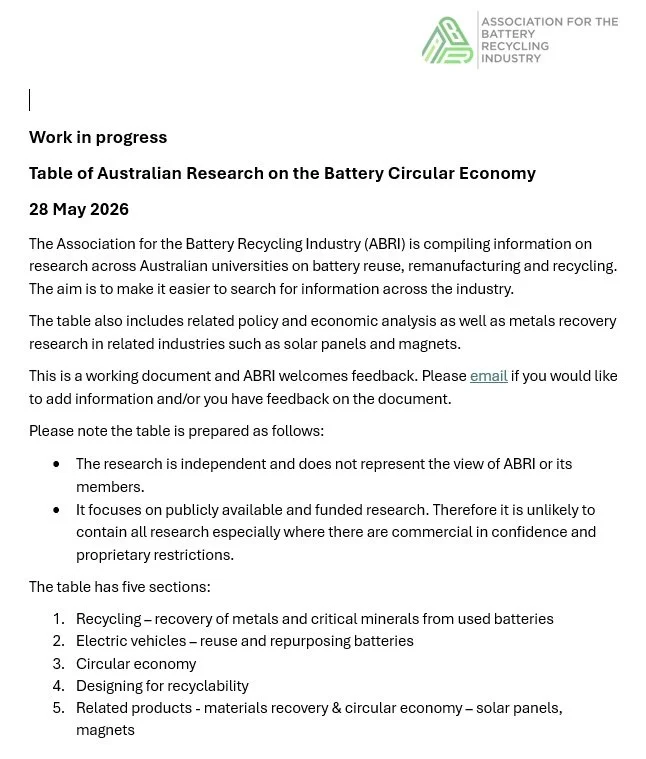
Australian research - battery circular economy - May 2026
New additions to the table are shaded in green. This includes a list of 2025 and 2026 research papers from the ARC Centre for Battery Recycling. Studies on the materials recovery and environmental benefits of battery recycling have been added to Section 3, Circular Economy.