Global demand for lithium-ion batteries is rising rapidly as electric vehicles, renewable energy storage and consumer electronics become central to modern life. With that growth comes a corresponding opportunity to reuse, repurpose and recover the metals in the batteries at end of life.
Australia is already seeing this shift. The volume of end-of-life batteries in Australia is projected to grow from around 198,000 tonnes in 2024 to more than 744,000 tonnes by 2050, with lithium-ion batteries expected to dominate as EV uptake accelerates.
As the energy transition accelerates, it is increasingly important to ensure these batteries are recovered and recycled safely to support Australia’s circular economy.
Why battery recycling matters now more than ever
The Association for the Battery Recycling Industry (ABRI) represents Australian companies across the battery manufacturing, distribution, reuse, end of life management and metals recovery value chain. Our members recognise that lithium and lead acid batteries sold in Australia become a valuable resource at end-of-life.
When managed responsibly, end-of-life batteries can be recovered and processed to reclaim valuable materials including lithium, nickel, cobalt, copper and lead. When they are landfilled or exported without appropriate oversight, those same batteries can become environmental and safety liabilities.

Processing end-of-life batteries locally:
supports Australian jobs
strengthens critical mineral supply chains
reduces environmental impacts
improves national resource security.
As ABRI notes in its industry profile:
“With the right policy settings, battery reuse, repurposing and recycling will not only safeguard Australia’s environment but will support its critical minerals future and provide many jobs and economic opportunities along the way.”
Lithium-ion battery end-of-life processing
Australia already has a growing battery recovery ecosystem.
Across the country there are:
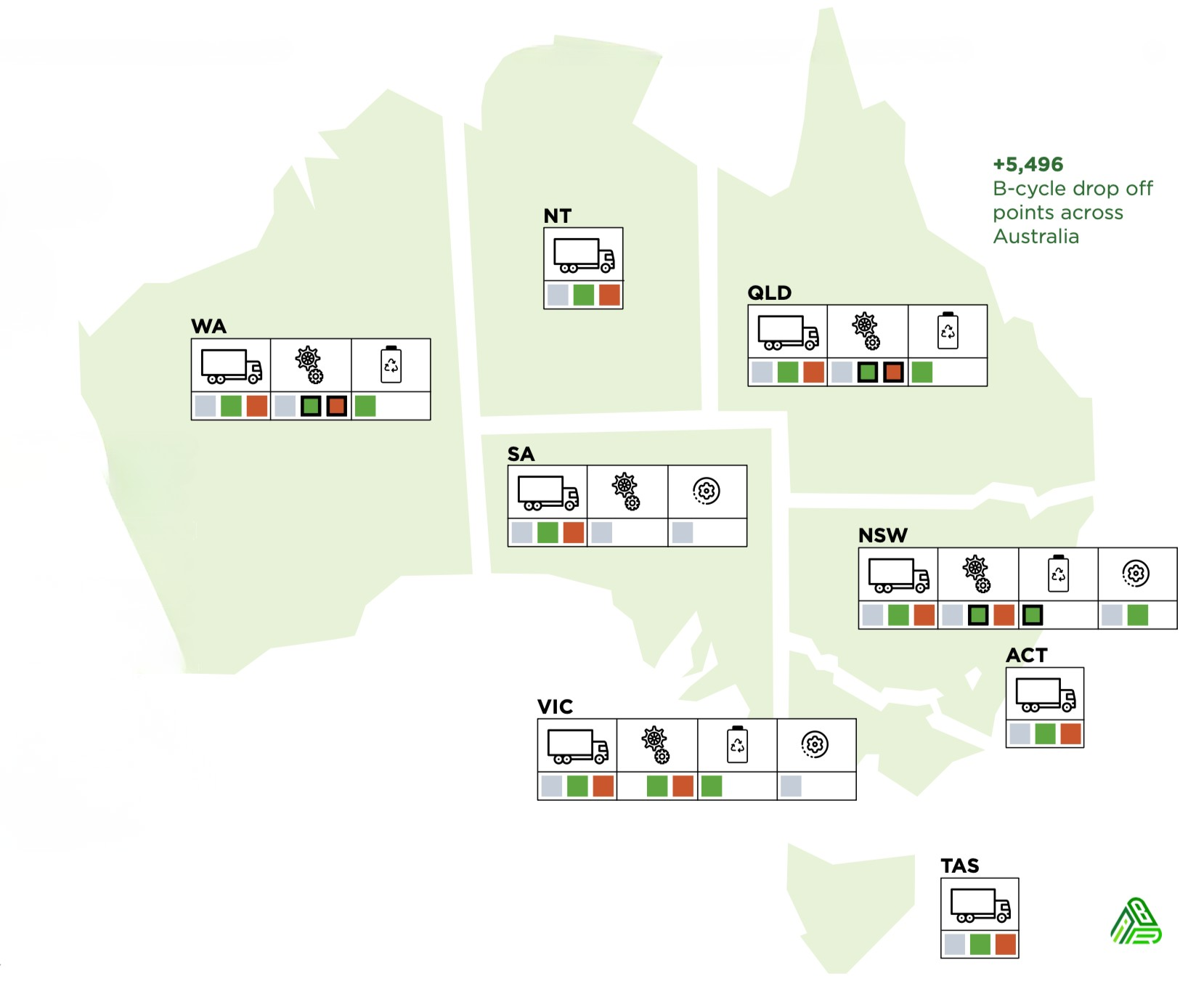
more than 45 battery recovery facilities operating across collection, processing and recovery activities
almost 5,500 B-cycle drop-off points where Australians can safely dispose of batteries
These facilities form part of a broader ecosystem that includes logistics providers, recyclers, metal refiners and emerging EV battery repurposing operations.
However, Australia still faces a major challenge. Lithium-ion battery recycling is far less mature than lead-acid battery recycling.
While over 90% of lead-acid batteries are recovered and recycled, lithium-ion battery collection rates remain significantly lower and infrastructure is still developing.
Expanding Australia’s ability to safely collect and process lithium-ion batteries will be essential as the end-of-life battery stream grows.
Why onshore Li-ion battery recycling is critical
Battery recovery plays an important role in Australia’s broader strategic priorities. As the industry profile notes:
“Battery recovery advances Australia’s critical minerals, national security and circular economy goals.”
Critical mineral processing is currently concentrated in only a small number of countries. Recovering battery materials locally can help diversify supply chains and improve resilience for downstream industries.
Australia’s battery recycling industry already demonstrates the potential of circular systems. The recovery of lead-acid batteries is widely regarded as one of the world’s most successful recycling systems, with recovery rates exceeding 90%.
As lithium-ion battery volumes grow, the industry is working to apply similar circular economy principles across new battery chemistries.
Environmental and emissions benefits of battery recycling
Responsible battery recycling delivers major environmental benefits.
Producing battery materials from recovered batteries is significantly more resource-efficient than extracting them through mining. Research cited in ABRI’s industry profile shows that producing battery-grade lithium and cobalt from recycled lithium-ion batteries can require up to 96% less raw material than mining new resources.
Recycling also supports emissions reduction.
Analysis indicates that producing batteries using recovered materials could avoid more than 17,000 tonnes of CO₂-equivalent emissions, roughly equivalent to removing more than 7,400 passenger vehicles from the road.
Equally important are safety considerations. Incorrectly disposed batteries can cause fires in waste collection vehicles and recycling facilities. Industry estimates suggest more than 10,000 battery-related fires and heat events occur in the waste sector each year, highlighting the importance of proper disposal and recycling systems.
Every battery recovered represents both an environmental safeguard and an opportunity to retain valuable materials within the economy.
Economic opportunities
Battery recycling is not only an environmental necessity. It is also an emerging economic opportunity.
According to ABRI’s industry profile, the Australian battery materials recovery ecosystem already:
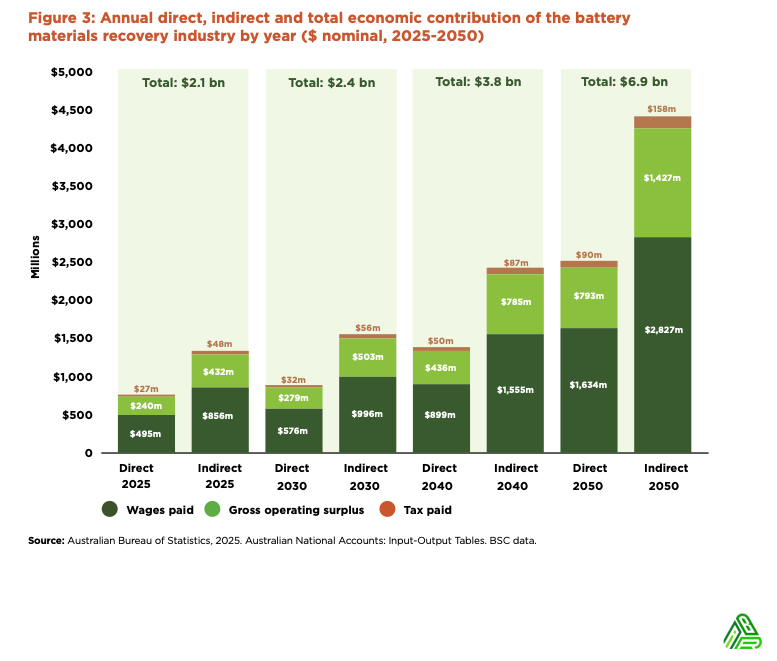
contributes $2.1 billion annually to Australia’s GDP
supports 19,450 jobs across direct and indirect activities
includes significant private investment in recycling infrastructure.
Direct battery recycling industry activity alone contributes:
$760 million in GDP
11,360 jobs
$500 million in wages annually
With the rapid growth in end-of-life batteries, the industry has the potential to expand significantly.
By 2050, the battery recycling sector could contribute:
$6.9 billion annually to GDP
34,650 jobs nationwide
This growth highlights the opportunity for Australia to develop a sophisticated battery recovery industry that complements its existing strengths in critical minerals and advanced manufacturing.
Building Australia’s circular battery economy
ABRI’s position is that, wherever technically feasible, end-of-life batteries sold in Australia should be processed under Australian-equivalent environmental and safety standards.
Onshore processing strengthens domestic capability, supports material traceability and reduces risks associated with transporting hazardous battery waste internationally.
ABRI’s role in shaping the future of battery recycling
ABRI represents manufacturers, distributors and retailers, reuse, end of life management and metals recovery businesses s across Australia’s battery value chain.
The association works with the federal and state governments on:
policy development
safety standards
producer responsibility frameworks
industry best practice
infrastructure planning.
ABRI also promotes public awareness about proper battery disposal and supports collaboration across industry, research institutions and government.
The goal is clear: ensure that end-of-life batteries are treated not as waste, but as strategic resources that can power Australia’s circular economy.
Article References
Association for the Battery Recycling Industry (ABRI), Battery Materials Recovery Industry Profile, January 2026.
Industry profile data and reference sources
Data and reference sources
Australian Bureau of Statistics, 2025. Australian National Accounts: Input-Output Tables
Australian Bureau of Statistics, 2020. Survey of Motor Vehicle Use, Australia
Battery Stewardship Council, 2025. Annual Report Financial Year 2025
Battery Stewardship Council data, 2025. (Not published).
Department of Industry, Science and Resources, 2024. National Battery Strategy
Internal ABRI research
Mohammed, R & Langdon, R., 2023. B-cycle Benchmarking Program: Life Cycle Analysis
Primary data from the ABRI member survey (circulated during October 2025)
United States Environmental Protection Agency, 2025. Lithium-Ion Battery Recycling