Global demand for critical minerals is forecast to quadruple by 2050, and this year's Battery Recycling & Manufacturing Summit made clear that Australia's battery recycling industry intends to be part of meeting it.
The 2026 Summit, ABRI's largest to date, brought collectors, recyclers, manufacturers, researchers, regulators and investors into the same room in Melbourne. The question running through all of it was how Australia builds its battery materials industry and captures the materials value and consequently removes batteries from the waste stream.
Here's what the day told us.
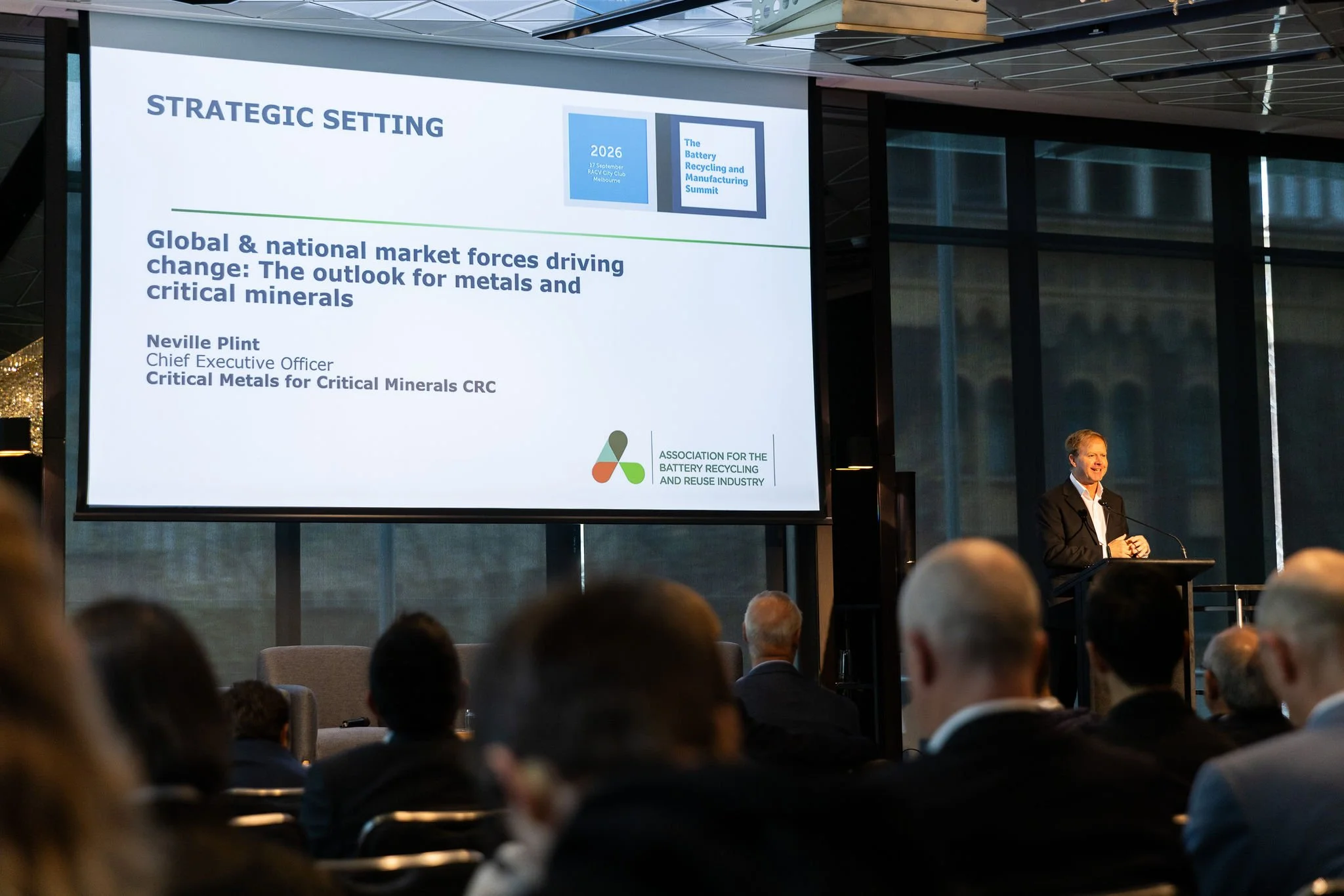
CMCI CRC CEO Neville Plint spoke on the market forces driving change at the 2026 Battery Summit.
Critical minerals sovereignty is no longer a talking point
Neville Plint, CEO of the Critical Metals for Critical Industries CRC, opened the day with a look at the global and national market forces reshaping demand for metals and critical minerals. That framing set the tone for everything that followed.
Australia's own battery materials recovery industry already contributes over $2 billion to GDP, and industry modelling suggests that figure could more than triple by 2050 as recovered lithium, cobalt and nickel support the growth of a domestic recycled metals supply chain.
"Seeing this many operators, including smelters, in the same room, working through the same problem, tells you this industry has moved past proving the concept," said ABRI Chief Executive Officer Katharine Hole.
"The infrastructure, the research and the skills are already here. What this sector needs now is government recognition of its value and clear policy direction to build at scale."
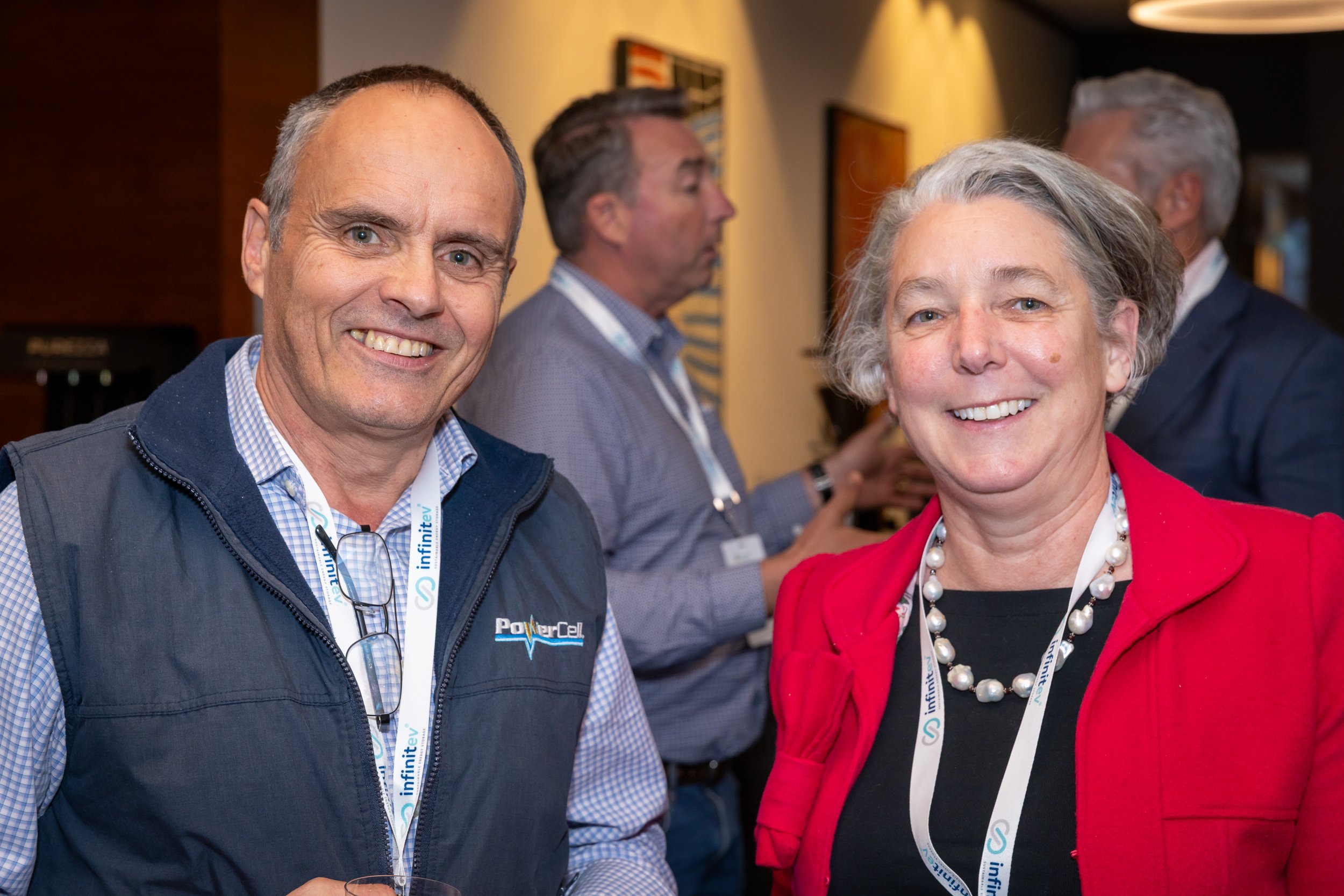
ABRI CEO Katharine Hole and Board Member Simon Cox.
The infrastructure is already being built
Real refining and processing infrastructure for critical minerals is expanding across Australia, and this year's Summit put that growth on full display.
Presentations throughout the day pointed to processing and refining capacity growing across a range of metals, including zinc, lead and lithium, with new and expanding facilities working toward meaningfully larger annual output over the next several years.
Much of that growth is being driven by demand for recovered critical by-products such as copper, cobalt and nickel, materials.
Together, these developments point to the emerging shape of a genuine sovereign battery materials sector, one built on local processing.
Technology is changing how batteries get sorted
Technology was one of the clearest signs of how quickly this industry is maturing, metallurgy, and sorting is where some of the most interesting advances are happening.
A cluster of specialised industries has been quietly taking shape across Australia. Together, they're what make battery recycling and reuse safe, efficient, and scalable, and they're creating a wave of jobs and skills that didn't exist a decade ago.
The Summit's technology showcase set out clear examples of the R&D and innovation work taking place around Australia.
Technology was one of the clearest signs of how quickly this industry is maturing, and sorting is where some of the most interesting advances are happening.
New systems combine imaging, sensors and automation to identify a battery's chemistry, condition and risk level in real time, directing sorting decisions without relying on manual inspection. The shift toward automated, real-time risk detection is a meaningful safety upgrade.
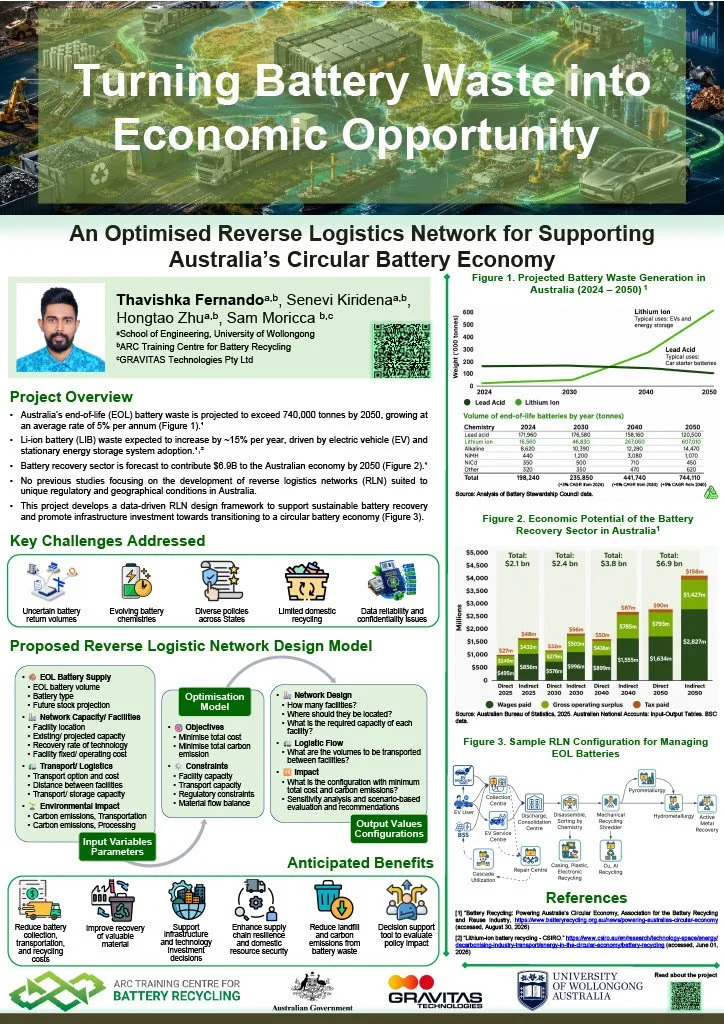
The ARC Training Centre for Battery Recycling used the Summit as a platform for sharing information on its research work with poster displays exploring solutions to industry challenges including optimising reverse logistics (further details at end of article).
Circularity is now a condition of doing business
Perhaps the most consequential shift discussed at the Summit had nothing to do with technology.
Circularity in design and decommissioning has moved from an afterthought to a core requirement, now sitting as a genuine condition of development approvals and project financing.
End-of-life planning and material recovery pathways are being scrutinised at the same stage as engineering and design. Investors and regulators are increasingly treating circularity credentials as a real risk factor rather than a point of difference.
Compliance is catching up to that shift, with conversations throughout the day returning to how compliance and assurance processes need to evolve alongside the industry.
Megan Chau, lawyer at Hamilton Locke, chaired a panel on grid-scale solar and battery projects, unpacking where circular economy obligations now intersect with renewable infrastructure delivery. The discussion supported the notion that legal and compliance obligations around circularity are becoming as central to project delivery as the engineering itself.
Skills and standards the quiet enablers
Every part of this industry, whether it's refining capacity, AI sorting or compliance reform, depends on having a skilled workforce to run it and industry standards to support safey and consumer confidence, and that point ran through the whole day.
Industry partnerships with the research sector and TAFE were highlighted as the driving force behind real advances in recovery, safety and operational standards. Melissa Jones from the TAFE Centre of Excellence for Clean Energy Batteries spoke directly to this, presenting on the training pathways needed to support industry growth and safety as the sector scales.
The workforce pipeline is as strategic an asset as any refining facility, and it deserves the same level of investment and attention. Technology and the infrastructure only get you so far without the people trained to operate and improve them.
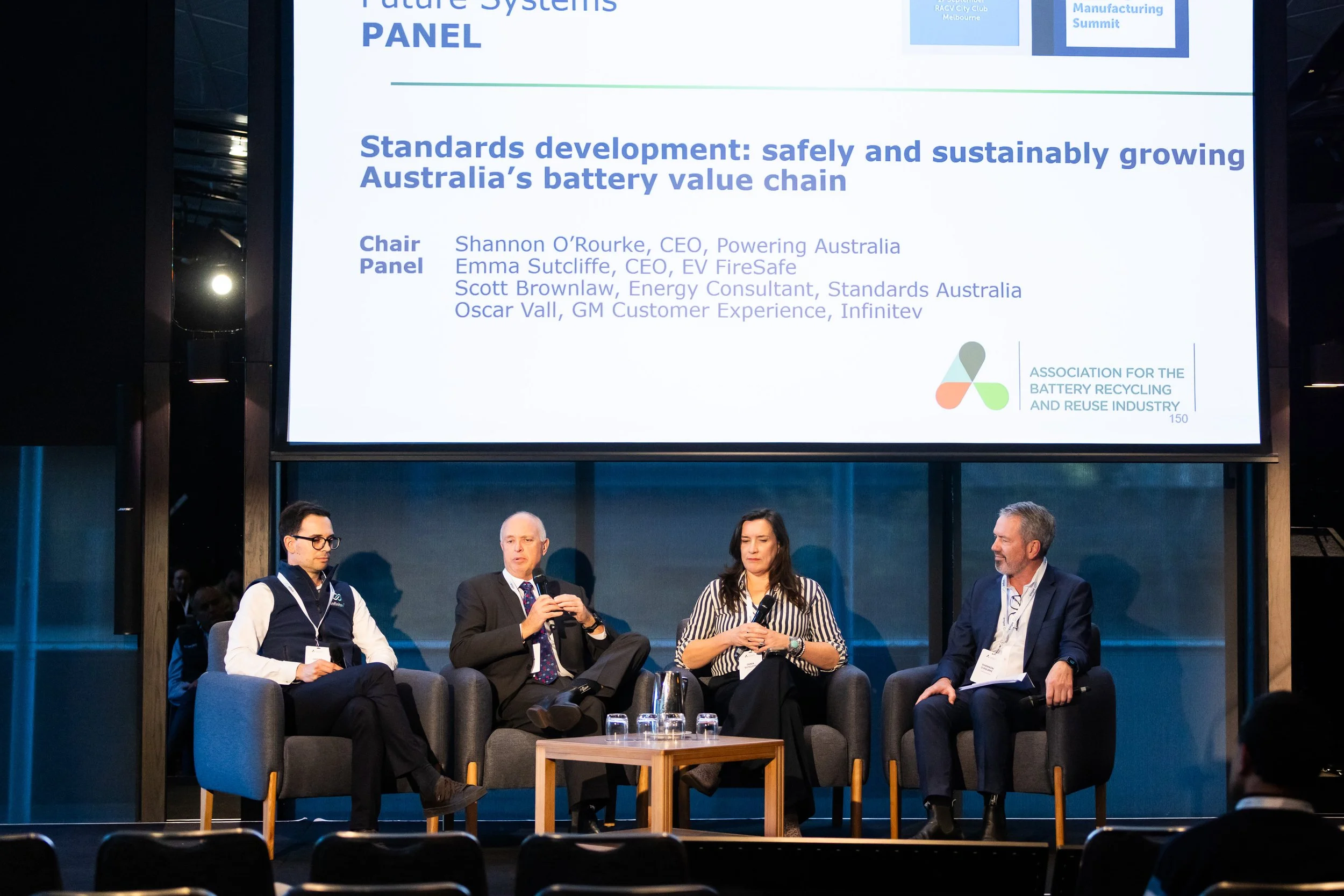
Powering Australia’s CEO Shannon O’Rourke lead a lively discussion on standards work underway and priorities for the sector.
Research is closing the gap
The Summit's exhibition floor included a poster display from the ARC Training Centre for Battery Recycling, a five-year research initiative based at the University of Adelaide's School of Chemical Engineering.
The Centre's work spans the entire battery recycling value chain, from dismantling and metal recovery through to material purification and the design of batteries that are easier to recycle in the first place. Their posters covered topics including the selective recovery of transition metals, integrating ESG and lifecycle assessment into circular economy planning, cell-level regeneration and reverse logistics network design.
You can view the full set of posters below.
Centre Overview
Selective Recovery of Transition Metals Using DES
Integrating ESG, LCA into battery circular economy
Cell level regeneration for sustainable battery recycling
Optimised reverse logistics network for a battery circular economy
What's next for the industry
ABRI is using feedback gathered through the Summit's live polls to shape its strategic priorities across advocacy, networking, industry growth, promotion and market intelligence over the year ahead.
The next stop is WA Battery Day in Perth, held in conjunction with Edith Cowan University and the WA Department of Energy and Economic Diversification, on 29 October 2026. The next full Summit returns in 2027.
For an industry moving this fast, staying in the room matters. If your organisation has a stake in how Australia recovers, processes and manufactures with battery materials, ABRI membership is where that conversation happens year-round.